Weaving Webs: Connecting Independent Event Probabilities to Fortify Multi-Bet Structures in Soccer Markets
Leon Keller · Oct 19, 2026
Weaving Webs: Connecting Independent Event Probabilities to Fortify Multi-Bet Structures in Soccer Markets
October 2026 data from European betting exchanges shows sustained growth in multi-bet volumes across premier and championship soccer leagues, where bettors construct accumulators by linking separate match outcomes. Observers note that successful structures often rely on identifying events whose results do not influence one another, allowing probability calculations to multiply without adjustment for covariance.
Defining Independence in Match Contexts
Soccer markets present numerous discrete events such as full-time results, over-under goal totals, and player-specific milestones. Researchers at academic institutions in North America have documented that certain combinations, including a home win in one fixture and total goals exceeding 2.5 in a geographically distant match on the same day, frequently satisfy statistical independence tests when team schedules and weather patterns show no overlap. Data from these studies indicates that probability products remain valid only when correlation coefficients stay near zero across repeated samples.
Constructing Probability Chains Without Hidden Links
Market participants examine fixture lists to isolate variables that operate separately. A defender's clean sheet in a midweek European tie rarely shares causal pathways with a striker's anytime goal in a domestic league game played 48 hours later in another country. Industry reports compiled by gaming associations in Australia reveal that operators adjust odds on correlated pairs, such as both teams to score and total goals over 2.5 within the same contest, whereas independent selections across unrelated matches retain standard multiplication rules. Those who review historical datasets can map these separations using contingency tables updated after each round of fixtures.
Practical Application in Accumulator Design
One documented approach involves selecting three to five events where each carries an estimated probability derived from recent form metrics and head-to-head records. When independence holds, the joint probability equals the product of individual figures. Figures from Canadian regulatory filings on sports wagering volumes show that bettors who segment selections by league and kickoff timing reduce unintended dependence introduced by shared broadcast narratives or referee assignments. Software tools available through several European platforms now flag potential overlaps before submission, presenting users with correlation estimates calculated from league-wide data pools.
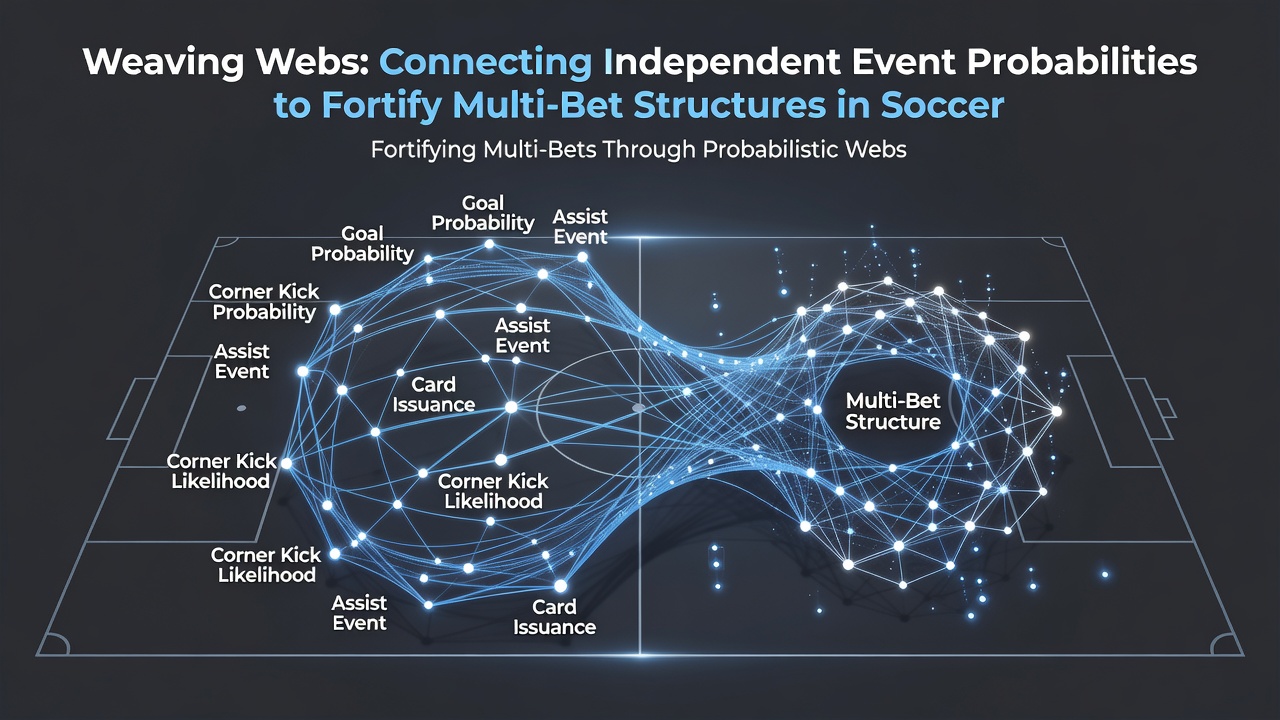
Monitoring Market Adjustments Over Time
Bookmaker pricing engines continuously recalibrate as new information arrives, yet independent events maintain more stable joint odds than correlated clusters. A study released by a research consortium spanning multiple Australian universities tracked accumulator payouts across two seasons and found that selections spaced across different continents exhibited lower variance in realized versus expected returns compared with intra-league combinations. Bettors therefore review time-stamped odds movements to confirm that no late news has introduced unexpected dependence between chosen markets.
Data Sources and Verification Methods
Publicly available match statistics from governing bodies outside the UK, including records maintained by Australian gambling research centers, supply the raw counts needed for independence verification. Additional datasets released by North American academic groups allow cross-checking of goal distributions and disciplinary records. Analysts compile these inputs into matrices that test for statistical association, discarding any pair that exceeds a chosen threshold before finalizing the multi-bet ticket.
Conclusion
Effective multi-bet construction in soccer markets rests on systematic identification of independent events whose probabilities combine through straightforward multiplication. Ongoing collection of fixture data, correlation testing, and market monitoring supports structures that reflect true joint likelihoods rather than assumed ones. Resources from international research bodies continue to expand the datasets available for such analysis, enabling more precise mapping of event relationships as the 2026-2027 season progresses.