Weekend Fixture Divergences: Aligning Scanner Alerts With Stake Division Across Multiple Football Markets
Bianca Klein · Aug 15, 2026

Weekend Fixture Divergences: Aligning Scanner Alerts With Stake Division Across Multiple Football Markets
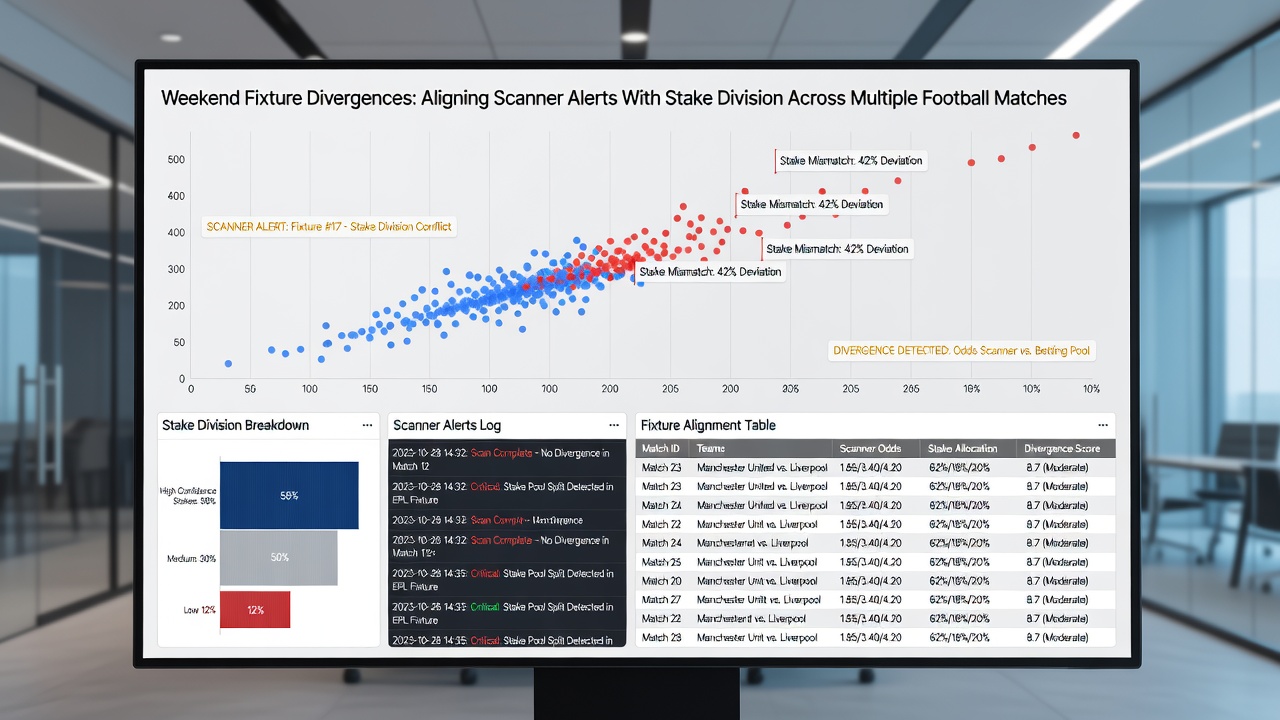
Football betting scanners process live odds from various bookmakers and flag potential value opportunities across weekend fixtures, yet successful bettors must align those alerts with disciplined stake division to manage exposure across several markets at once. Data from the 2025-2026 season shows that European football weekends typically feature over 140 matches spanning top divisions, creating numerous entry points for automated alerts on outcomes such as match result, both teams to score, and total goals. Observers note that divergences appear when scanner outputs highlight conflicting signals between correlated markets, requiring bettors to adjust allocation percentages rather than treat each alert in isolation.
Scanner Mechanics in Weekend Contexts
Automated tools scan for discrepancies between implied probabilities and offered odds, often focusing on leagues with high fixture density during August and September periods when schedules resume after summer breaks. Research published in the Journal of Gambling Studies indicates that alert volume rises by approximately 18 percent during these months because bookmakers adjust margins in response to increased betting traffic. Those who monitor scanner logs report that alerts frequently cluster around popular Premier League and Bundesliga fixtures while lower-profile matches in the Championship or Eredivisie produce steadier but smaller edges. Effective alignment begins when users categorize alerts by market type and fixture timing, grouping them into clusters that share similar risk profiles rather than acting on each notification independently.
Stake Division Across Correlated Markets
Stake allocation follows a structured model where total bankroll exposure per weekend is capped, then subdivided according to alert strength and market correlation. Experts have observed that dividing stakes between match-result and over/under markets on the same fixture reduces variance compared with concentrating funds on a single outcome. Figures from the Australian Gambling Research Centre reveal that bettors who apply proportional sizing across three or more markets per fixture maintain steadier returns over a 12-week sample period than those who use flat stakes. When a scanner flags value on both a home win and under 2.5 goals, allocation might split 60 percent and 40 percent respectively after accounting for the negative correlation between those selections. This method prevents over-commitment while still capturing the combined edge identified by the tool.
Handling Divergences in Multi-Market Alerts
Divergences occur when one market alert suggests a different probability distribution than another for the same fixture, prompting adjustments in stake ratios. A scanner might detect value on both-teams-to-score yes at one bookmaker while simultaneously highlighting over 2.5 goals at another, even though the two outcomes share statistical overlap. Bettors address this by recalibrating stake weights to reflect the degree of independence between the markets, often reducing individual bet sizes by 15 to 25 percent when overlap exceeds 40 percent. Data compiled by the Ontario Lottery and Gaming Corporation shows that Canadian sports bettors who implement such recalibrations experience lower drawdown periods during congested fixture weekends. Practical application involves reviewing historical hit rates for paired markets before finalizing allocations, ensuring that stake division mirrors the actual divergence rather than the raw alert strength.
Practical Application During August 2026 Fixtures
As the new European season begins in August 2026, scanners are expected to generate heightened alert volumes because opening-weekend odds often contain larger initial margins. Those tracking early fixtures note that stake division models benefit from smaller initial positions until sufficient data emerges on team form and line-up changes. Allocation frameworks typically reserve 30 percent of the weekly betting budget for the first round of matches, allowing remaining funds to target midweek corrections once scanner data updates. Industry reports from the European Gaming and Betting Association indicate that structured stake division across opening weekends correlates with more consistent performance metrics over the subsequent months. Bettors who integrate fixture timing into their allocation rules avoid the common pattern of front-loading exposure on high-profile Saturday matches at the expense of Sunday and Monday opportunities.
Monitoring and Adjusting Allocations
Continuous review of scanner performance against actual results enables refinement of stake division rules across multiple markets. Weekly performance tracking reveals whether alerts in specific leagues require higher or lower allocation percentages based on realized edge. Academic analysis from the University of Nevada, Las Vegas Center for Gaming Research demonstrates that dynamic stake adjustment models outperform static percentage systems by approximately 9 percent in long-term return metrics. When divergences between alerts widen beyond predetermined thresholds, allocation percentages shift automatically to limit combined exposure. This approach maintains discipline while allowing the scanner outputs to guide decisions without overriding risk parameters.
Conclusion
Weekend fixture divergences require bettors to integrate scanner alerts with systematic stake division across multiple football markets rather than treating notifications as standalone opportunities. Structured allocation that accounts for market correlations and fixture clustering supports sustained participation through high-volume periods such as the August 2026 season start. Data from regulatory and academic sources consistently shows that proportional sizing across related markets produces more stable outcomes than isolated bet placement. Those applying these methods maintain exposure limits while responding to the value signals generated by scanning tools.